
Who on earth goes to Provence in January you might ask? Well, if the girls are going, so am I, I always say, and this time it was 16 friends from the American Women's Club here in London. Was it sunny? Yes. Was it warm? Uh, no. Was it crowded like Provence can sometimes be? Not in the least!

After arriving in Marseilles, we headed straightaway to the deserted hillside-perched village of Les Baux de Provence. It was once a thriving stronghold in the 10th century for the feudal lords of Baux who claimed to be descended from Balthazar, one of the legendary Wise Men. With the star of Bethlehem on their tunics as inspiration, they controlled 79 surrounding cities at their peak of glory.

From the view of their ruined castle, and with the chain of the Alpilles mountains in the background,

it's an amazing experience imagining what it must have been like

to live at such "altitudes" of power.
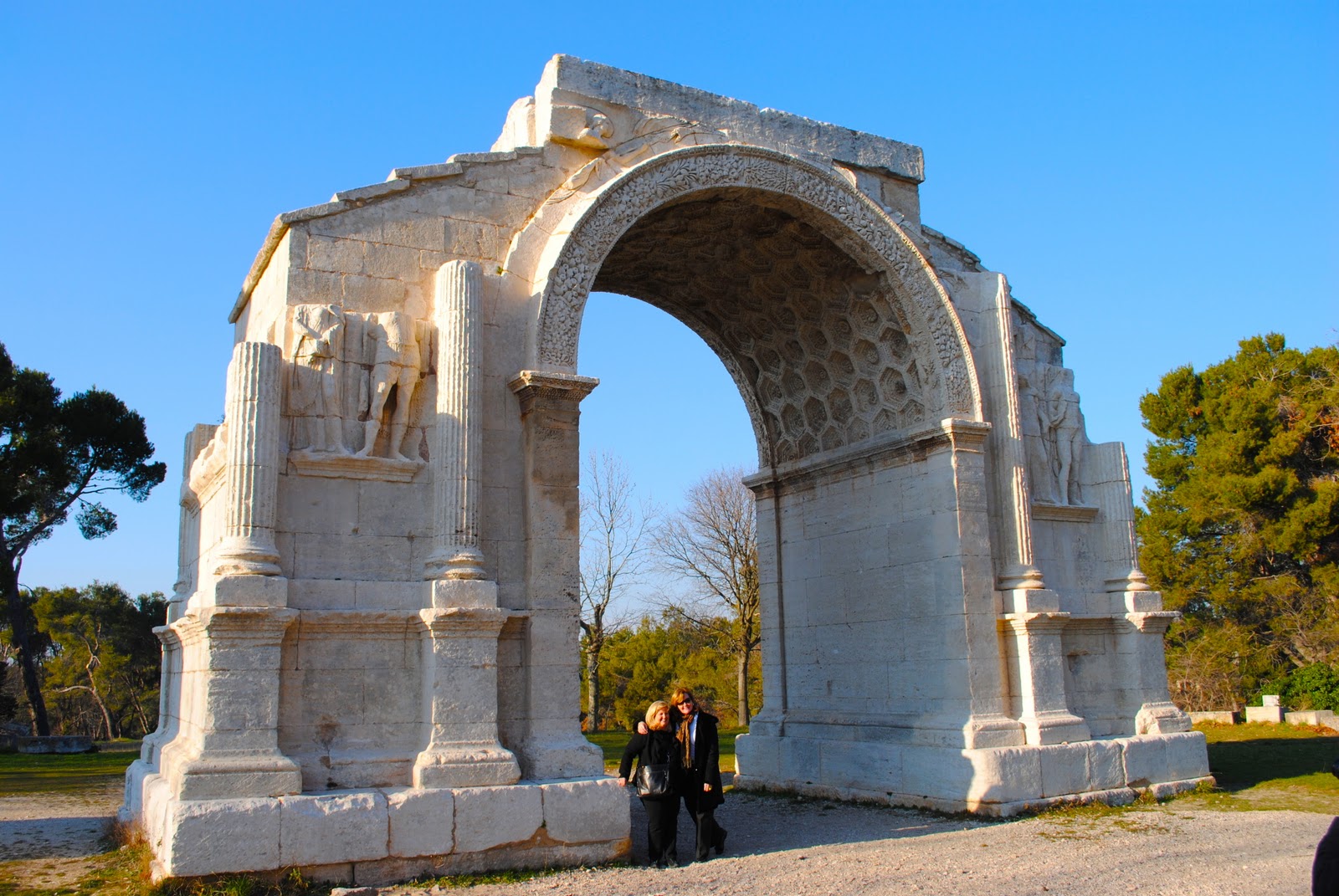
Moving on, we stopped at the Roman ruins of Glanum, a fortified town founded in the 6th century B.C. The triumphal arch is considered to be one of the first of its kind in Provence and was situated just outside the northern gates of the ancient city.

Next to the arch is the 60 foot high Mausoleum of the Julii, which dates to about 30 B.C. and is thought to be the burial tomb of a mother and father, erected in their honor by their three sons, whose names are inscribed on the side, along with some beautiful bas-relief designs. It is generally considered to be one of the best preserved mausoleums in the whole Roman world.
Right there in the south of France!

Our resting place the first day was the nearby town of St.-Rémy-de-Provence, one of the typical Provence villages covered up with tourists in the summer. We found empty squares, welcoming restaurants, and quiet atmospheric streets, tempting us to come back and be a part of the action when the city wakes up for the summer season.

Another day of sun found us on our way to Avignon, where we spied its famous bridge, originally 22 arches across when it was built in the 12th century, but today standing short of that with only 4 arches. Immortalized in the children's folk song, Sur Le Pont d'Avignon, it had been ravished by the Rhone River on several occasions and the citizens opted not to rebuild it.

Perhaps Avignon is best known for the time it served as the seat of the papacy from 1309-1377 when popes fled the corruption of Rome. Sometimes referred to the Babylonian Exile, seven popes lived there in the formidable Palais des Papes,

in what is recorded as a decadent, luxurious lifestyle.
Strolling the city revealed hidden treasures and lovely squares, which were once again very quiet during the winter season.

I leave you for now with a favorite impression--the antique French carrousel in the Place de l'Horloge-- and with a promise of more Provence impressions in the days to come.
So with spring just peeking its head around the door and new beginnings at our reach, remember to Grab the Brass Ring and live life to the fullest!




 Posts
Posts


