Showing posts with label Spain. Show all posts

Thursday, May 30, 2013

Tapas and Shopping in Spain


Eating in Spain is all about the Tapas experience--little portions


of food that just keep coming out for the table until everyone is more than satisfied.


Tis true that some of the items like these small fish might have been a new experience for our group, but they were actually tasty.


Here are some tapas that we enjoyed in Seville that were big winners.


Wouldn't be a trip to Spain without some paella,


and beautiful courtyard dining, 


with a little celebrating thrown in.


No matter where we roam, there's always shopping to be found,


and Spain was no exception. Fans for all occasions, both simple


and grand,


with a little bling and lace thrown in for fun.


Imagine wearing your hair worn up with one of these combs,


or accessorizing with these?


Beautiful Spanish tiles, both new and old


as well as pottery are very tempting.


Does your favorite matador need a new suit,


to go with your own party dress?


And of course, we can't leave out the little ones,


who dream of dressing like the big girls,


from head to toe.


So of course, at the end of the day, I came home with a flamenco dress for my favorite little dancer.

Now, I might need to go back for those matching shoes!!

Olé!

Tuesday, January 25, 2011

Adios to Spain


Our third day in Spain, we woke up to clouds, and so when we headed to the hillside


white-washed village of Mijas, 1400 feet above sea level,


we had to search a little harder for color, since the azure blue we had been experiencing was no longer our canopy.


We found color in the shops-- pottery


and flamenco dresses of all colors and sizes.


The look out perch offered spectacular views,


and the old walls of this hermitage built in the 1520's had a story to tell. Legend has it that the Virgin de la Peña appeared to two young shepherds in June of 1586 who had been led there by a pigeon. Subsequently, an image of the virgin appeared in a recess in a tower where it had been hidden for 500 years. Today the village people keep the little chapel decorated with flowers.


We moved on down the coast to our final destination of Malaga, another beautiful and modern Spanish city with almost 600,000 inhabitants. One of the oldest cities in the world, first founded by the Phoenicians in 770 BC,


its bullring lies smack in the middle of high rises in the center of the city. 


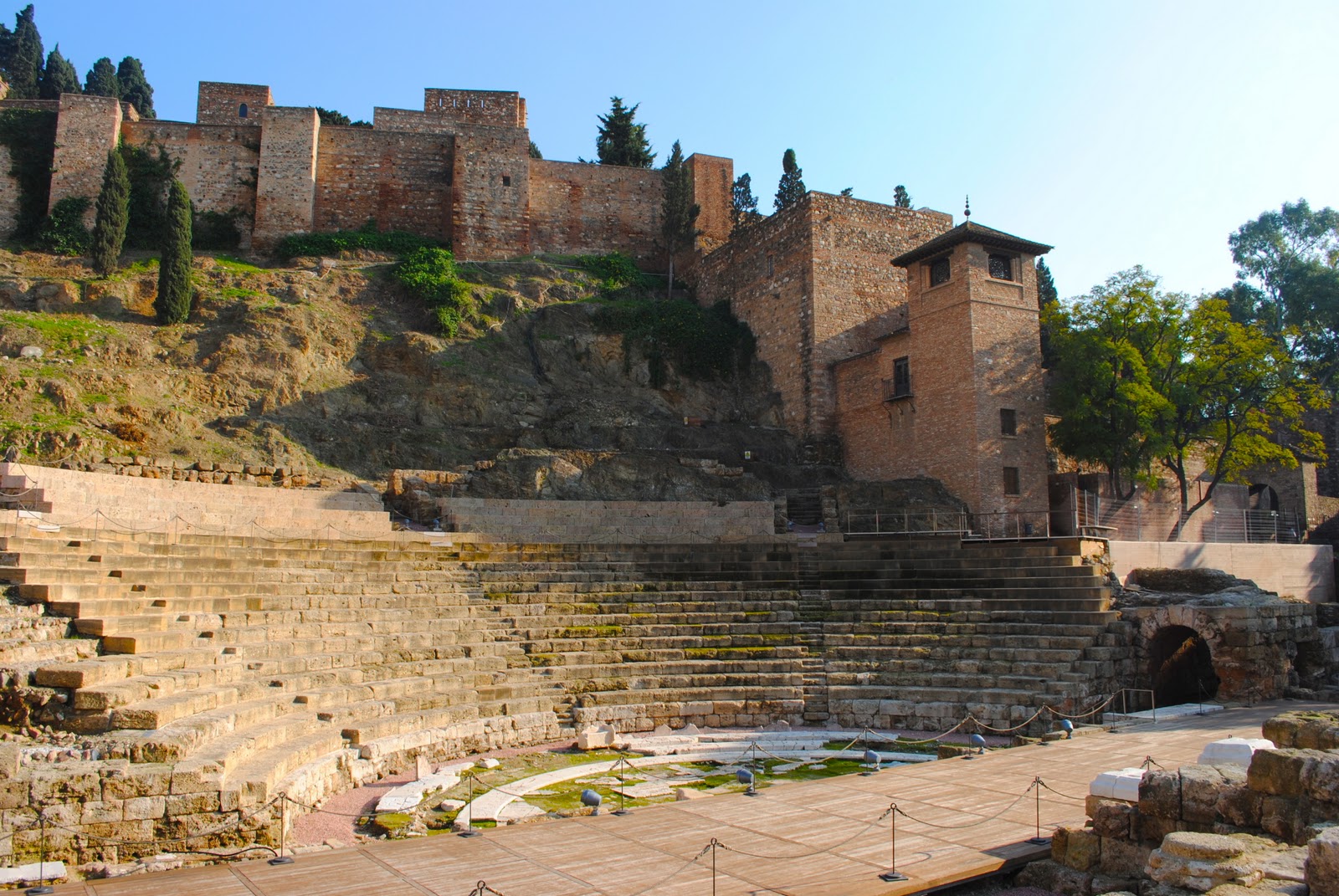
Roman ruins of an amphitheater date from the first century and lie in the shadow of the Alcazaba, a fortress first built in the 11th century.


One of Malaga's claims to fame is that it is the birthplace of Pablo Picasso, who gladly posed for pictures with us in front of  his birthplace with his sunglasses and baseball cap. We toured the Picasso museum, but as "interesting" as the paintings were, we were not allowed to photograph any of them for you, which is just as well, since I'm not sure I could have explained any of them to you anyway.

And just as impressive to me, is that Malaga is the birthplace of that cultural icon of Spain, and the voice of the most famous kitty we all love, Puss in Boots from Shrek---Antonio Banderas. Here's a little scoop--we'll be hearing him again in the spin-off from Shrek, "Puss in Boots-The Story of an Ogre Killer" to be released in November.


As the sun began to set on the day and on our stay in Spain, we took one last look at the Cathedral


and bid Adios to the beautiful Costa del Sol, with dreams of coming back again one day to retrace our steps.

Friday, January 21, 2011

Strolling through Ronda


Our second day along the Southern coast of Spain found us in the hillside town of Ronda.


Known for its spectacular views and fortress-like position,


it's perched 2400 feet above sea level and commands an amazing vista over the mountainous region inland from the coast. I love the contrast here of the fragile almond blossoms and the cactus.


Even though it was January, the almond trees were dressed in all their finery at the time we were there.


The city boasts one of the oldest bullrings in Spain, having been opened in 1785.


Pedro Romero, the town's most famous native son and the father of modern bullfighting, killed some 5,600 bulls here in his lifetime.


After being killed, the bull was hung up from this chain to be butchered.


We left the newer part of the city to cross over the New Bridge, finished in 1793, to the old town of La Cuidad which remained in Islamic or Moorish hands until the Christian Reconquest in 1485.


The bridge is an architectural marvel spanning the El Tojo ravine which is 360 feet deep and 210 feet wide.


Once inside the old Moorish town, we strolled its twisting narrow streets which still had a Medieval feel. Orange trees lined the streets and plazas. We found ourselves at the Palacio de Mondragon, which was built for Abomelic,the ruler of Ronda in 1314.


Three courtyards are situated inside,


through which you can wander and admire


its strong Islamic character, mosaics and coffered ceilings.


Through the horseshoe arch, so typical of the architecture of the town, we wandered out to a cliff-top garden, where from every angle,


the views were spectacular.


We were fascinated by many things, such as these doors cut out of the doorways,


charming white stucco houses,


and the ubiquitous Seville orange trees. The oranges from these trees taste a bit sour, and they are often sent back to England where they are made into orange marmalade.


We were entranced by the Iglesia de Santa Maria La Mayor, a grand cathedral which stands on the site of a former Islamic mosque. The tower and the galleries date from this time.


The mosque was destroyed when the Moors were overthrown, and it was rebuilt later as a church dedicated to the Virgin Mary. The main altar is heavy with gold leaf,


and the side chapels are just as lovely.


Our wanderings took us to the other side of the old town,


but Michelle Obama had preceded us last August on her holiday trip to Spain that caused such a ruckus.


We passed through the Philip V archway, built in 1742, and walked along the old city walls to get to the


ancient Arab baths dating from the 13th and 14th century with their steam rooms, massage rooms and hot and cold pools.


As the sun began to set, we gathered for final views along the restaurant terrace,


and reminisced about our favorite memories of a town that none of us will soon forget.