Showing posts with label Poland. Show all posts

Friday, December 7, 2012

Don't Count Calories in Poland!


Shortly after our London group's arrival in Krakow, we made a bee-line for lunch, of course, since many of us had been awake since 4 AM and Easyjet airlines offers no complimentary snacks nor drinks en route, thank you very much.


Just across from the salt mines we all settled in for a nice lunch in a cozy little restaurant which was our first clue that the food in Poland was not going to disappoint us. We started off with soup in a bread pot...


yummy mushroom soup to warm us up, and 


then it was time to check out the pierogis that Poland is known for. Our choice was a traditional and simple stuffing of potatoes and cheese, but the little dumplings so popular in a lot of eastern Europe can be filled with sauerkraut, mushrooms, meats, cheeses, or even fruits for a sweet finish.

It was a first for me--you don't see pierogis on a menu in Texas, but we knew it wouldn't be our last sampling during our stay.


For me dinner that night was an easy choice, since I love wienerschnitzel, which is translated as Kotlet Schabowy in Poland, and is one of the most popular comfort foods.

Polish cooking is hearty and filling, with a heavy emphasis on cream and eggs.


We had our second helping of pierogis that night for dinner--felt it was our responsibility, naturally, to compare this national dish everywhere we went, and they were just as good as our first sampling.


You can't count calories in Poland--spaetzle, more of a German dumpling, was also a side dish that  night for our table.


Probably our best meal in Krakow was in the Jewish quarter our second night when our group of 4 dined on turkey cutlets with cranberry sauce,


tender steak with fluffy potatoes and bearnaise sauce,


and pork with cherry sauce. Everything was over the top delicious!


Shortly before we flew out on Sunday evening, we stumbled onto a charming restaurant on the town square


where Hubby had smothered pork and cabbage, along with potatoes too, of course,


and I took advantage of the opportunity to have Kotlet Schabowy one more time. It was plated with German potato salad. Let me tell you, those Polish people eat a lot of potatoes in all forms and fashions.


I can't leave this topic without mentioning that the pretzel stands were everywhere for a quick snack,


but our most unusual find of all was fried broccoli on McDonald's menu. 
Not what I would order every time, but it was interesting to the taste buds.

We were surprised at the quality and the affordability of our meals there--a lot for not much money!

Polish restaurants in London are not that hard to find, and since coming back to Houston, I've checked out a listing of area restaurants, and was pleasantly surprised to find we have one here too. Sounds worth investigating to me!

Until then, I'm going to check my grocers' freezer section. Rumor has it that there are frozen pierogis nestled in among the appetizers. Let me know if you've tried them!

Thursday, November 29, 2012

A Somber Day at Auschwitz


Ironically, it was a beautiful, sunny fall day when we journeyed from Krakow and made our way to one of the coldest and darkest places on earth: the Auschwitz concentration camp, a network of concentration and extermination camps set up by the Nazis during World War II. Greeting us as we entered, was the iconic sign Arbeit Macht Frei, which translates as Labor Makes You Free.


There was no freedom here for the 1.3 million who died, 90% of whom were Jewish.


Auschwitz I, the base camp, was the administrative arm of the complex with its brick barracks, storage warehouses, prisoner cells, and an area for "experimental" medical testings,


and Auschwitz-Berkenau was known as the extermination camp where most of the "final solution of the Jewish question in Europe" was carried out.


Between 1922-1944, transport trains dropped off hundreds of thousands prisoners to this location, where upon disembarking, doctors would separate them into two groups, the young and hearty in one group, and then the children, mothers, ailing, weak and elderly were sent to the other side


where many were exterminated immediately. Three-fourths of the total prisoners


were selected to die. Those who remained prisoners in the labor camps suffered severe hardships, and often died of starvation, illness, or from the freezing conditions.


The barracks contained long rows of wooden bunks where the prisoners were forced to sleep on top of each other, often lying on their clothes so they wouldn't be stolen.
Records show that 800-1000 were sometimes crammed into the compartments of each barrack.


It was with great sadness that we read the names of  many like Maria, who were killed.


Seeing the faces of the children was most difficult of all.


When the prisoners disembarked from the trains, they were told to leave their possessions behind,


many of their personal items being gathered up and sent to "Kanada," a warehouse that stored their earthly possessions, and then were sent back to Germany to be distributed.


Canada symbolized wealth to the prisoners. Toiletries, cooking utensils, clothing and even hair were saved and were on display at the current exhibition.


Sweet touchstones of innocent babies and children who died way too soon.


We witnessed sites of the atrocities, the hanging square,


the Black Wall, where SS guards executed thousands,


and what was left behind of the crematoriums. Heartbreaking stories of families torn apart by the atrocities inflicted upon them.


I was privileged to travel with Joan who had a personal connection to the camp. She was named after her Jewish great-grandmother who had died at Auschwitz. When her grandmother finished her schooling, Joan's great-grandmother put her on a boat to America, sending her away, and on that day gave her the earrings off of her ears as she departed. Her great grandmother and some of her siblings later were sent to Auschwitz. Joan's family line was thus spared when her grandmother left Europe, and she owns those very earrings and wore them in her great grandmother's honor, the day we visited the camp.

This story is one of millions more of the people whose lives were lost in one of the world's most awful atrocities. It was extremely difficult to experience the surroundings, but it was a vivid reminder of the evil that can occur in this world if left unchecked and not challenged. May the memory of those lost remind us of the common humanity of us all and our responsibility towards our fellow man.


Tuesday, November 13, 2012

Tripping over to Krakow


When offered the chance to go to Krakow, Poland for the weekend with friends, Hubby and I jumped on the chance to explore an area that we really knew nothing about. Upon arrival, our group of 30 immediately went to the Wieliczka Salt Mines which were first built in the 13th century, and which continued producing table salt until 2007. 

Comprised of nine levels reaching to a depth of 1073 feet, and 190 miles in length, the salt mines are massive. Below ground is a virtual wonder-world including a labyrinth of tunnels, chambers, underground lake, and dozens of statues carved out of the naturally gray salt.


Thankful that we weren't headed down all 9 levels on our tour, we began our descent which eventually led us down 800 steps to the third level.


At a level of 135 feet below ground, we put the guys to work making them earn their keep.


We visited chamber after chamber appreciating the stories of the miners and the years of hard labor it took to withdraw the salt, and shore up the chambers as they did.


Most impressive to me were the 3 underground chapels, especially this large one, The Chapel of the Blessed King, illuminated with rock salt chandeliers, 164' long and 49' wide,


with an amazing altar, which was a work of art. Mass and weddings are still held in the Chapel of the Blessed King routinely, redefining the concept of "destination wedding!"


We were thankful to be above ground the next two days with beautiful and exceptional weather for November. Our walking tour of the Old Town included a stop at the Royal Castle and Cathedral of Wawel set high on a hill above the town.


Situated in the center of the Old Town is the Main Square, the largest medieval town square of any European City, which includes the Town Hall Tower,


Renaissance Cloth Hall, 


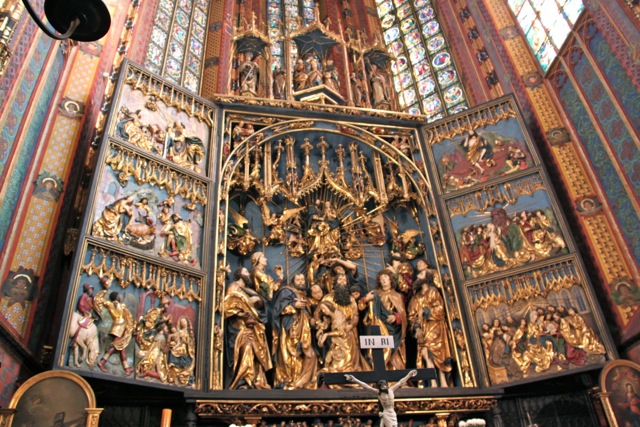
and one of my favorite stops, the St. Mary's Basilica.


Beautiful original stained glass


and a masterpiece of a Gothic wooden altarpiece, carved by Veit Stoss, which was stunning as it was revealed to us in a ceremony at mid-day when it was opened for all to see.


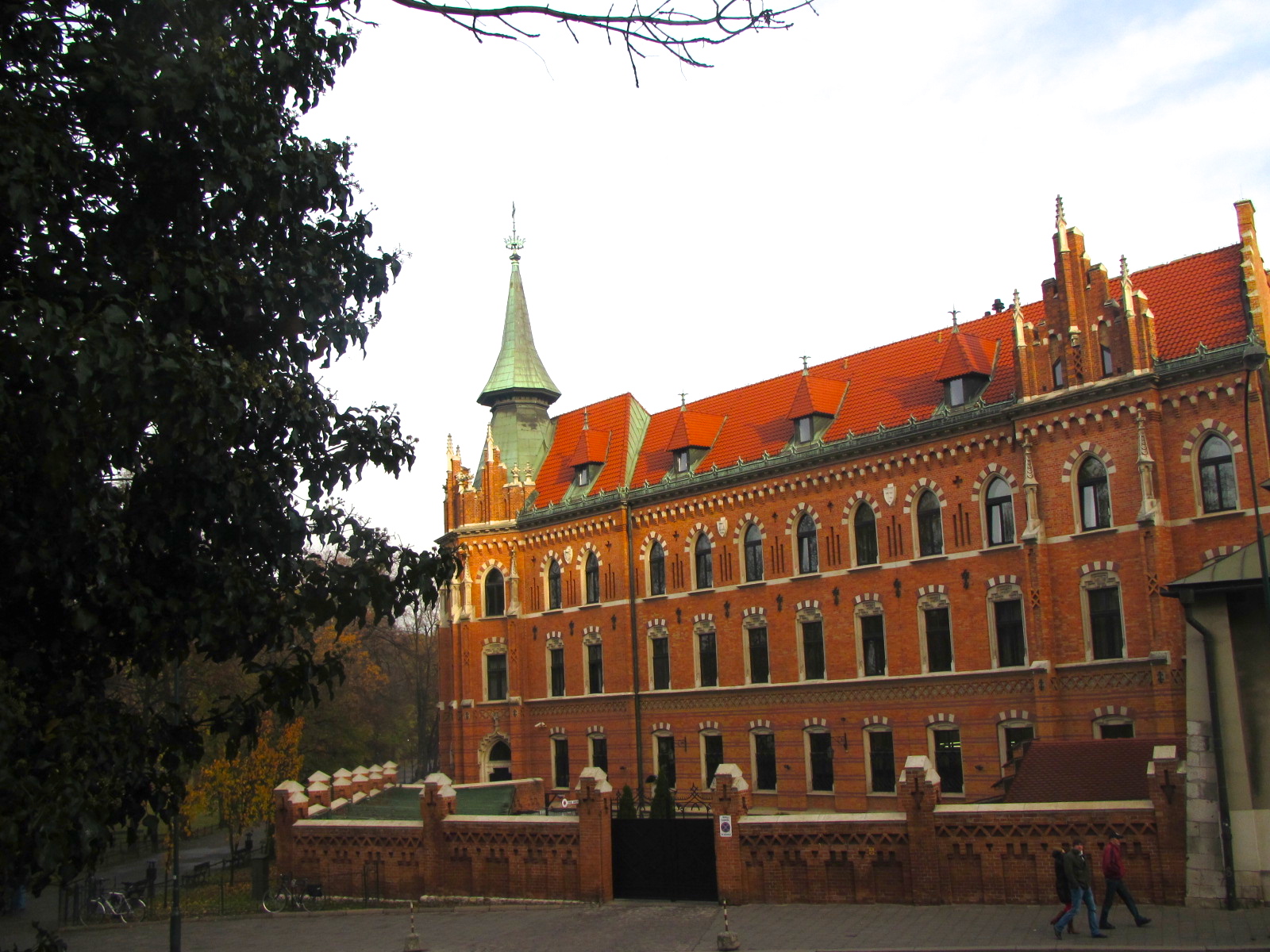
Strolling through the city revealed many historic styles of architecture


which caught our eyes along the way.


Especially soothing were the many parks around town


where we all enjoyed strolling, enjoying moments of peaceful thought in anticipation of what we knew would be a very difficult following day when we would travel to Auschwitz to experience the terrors of the Holocaust. 

Stay tuned for a few impressions of our excursion in my next blog.